 There is a wealth of information that can be found here. If you still have questions or you would like to book a course place please



Ninety-four percent of learners would recommend the 1-day leadership qualification jointly developed by the Health and Safety Executive and NEBOSH.
NEBOSH and L’OREAL ~ International Women’s Health and Safety Bursary 2024
BREAKING NEWS ~ Woodward SHE Ltd are delighted to be able to announce that NEBOSH have chosen ourselves as the Learning Partner to deliver the prestigious L’Oréal International Bursary 2024 training course. We look forward to welcoming the ten successful applicants onto the course this summer.
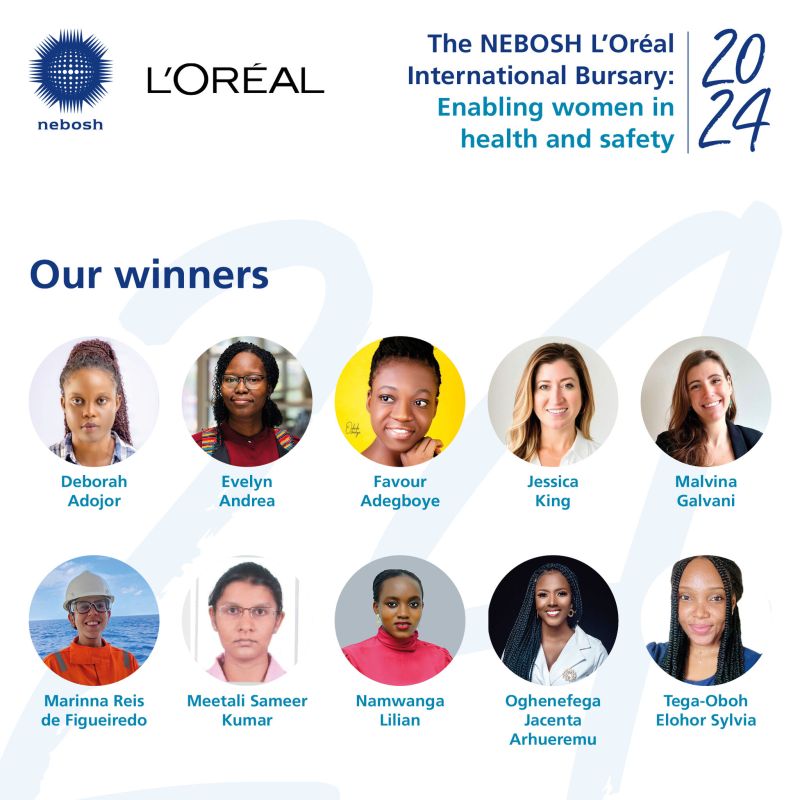
NEBOSH and L’Oreal have joined forces once again to collaborate on a bursary that supports women who aspire to build a career in health and safety in 2024.
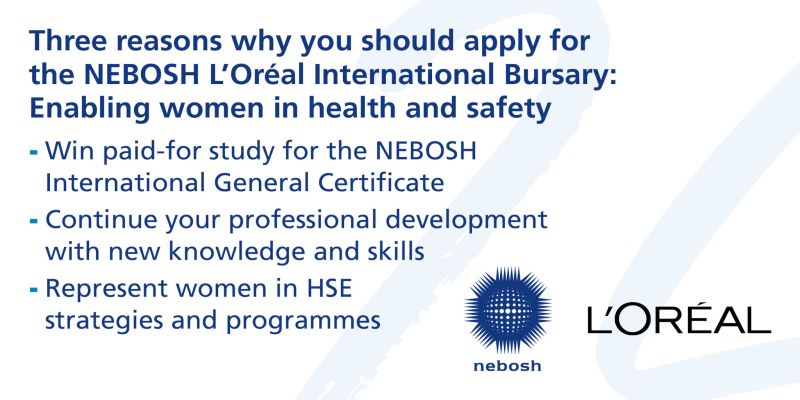
Following the success of last year’s NEBOSH L’Oreal International Bursary, which attracted nearly 200 applications from women all over the world, the bursary has now grown to accomodate double the amount of winners. This means that there is now the opportunity for ten women to win the opportunity to study for the NEBOSH International General Certificate with their study and assessment fees paid for by the bursary.
The aim of the bursary to develop more learning opportunities for women, and to address the under-representation of women in the health and safety industry, with some research indicating that women make up just 18-27% of those in the profession.
Maria Anderson, Global Head of Health, Safety and Wellbeing at Cambridge University Press & Assessment, holds four NEBOSH qualifications and is a member of the Bursary judging panel.
She says: “I am proud to be a part of the NEBOSH L’Oréal Bursary judging panel because it allows me the privilege of contributing to the recognition and support of women dedicated to occupational health and safety, an initiative that promotes diversity, equity, and inclusion in the workplace. Being entrusted with the responsibility to evaluate and reward the passion, commitment, and innovation demonstrated by applicants is not only an honour but also a testament to the importance of fostering excellence in safety practices. Together, we empower the next generation of professionals to make a lasting impact, creating a safer and healthier workplace for all. I look forward to working with my fellow judges to identify and support the next generation of leaders in this field.”
The bursary is open to any woman based outside of the United Kingdom, and applications can only be submitted through the NEBOSH L’Oréal International Bursary Application form.
Applications close on the 27th February 2024 at 5pm UK local time.
NB: Applications for this bursary are now closed.
NEBOSH Ethical Practice Report (July-September 2023)
There are no easy routes to a NEBOSH qualification. Learners have to study hard and complete rigorous assessments, demonstrating their knowledge and understanding. That’s why NEBOSH qualifications are valued by professionals and organisations around the world.
Unfortunately, some people try to cheat to gain a NEBOSH qualification. NEBOSH therefore has strict processes and dedicated experts to prevent and detect malpractice.
NEBOSH has recently updated its Malpractice Policy to add clarification about the use of AI in assessment answers and has implemented additional checks for these into their systems.
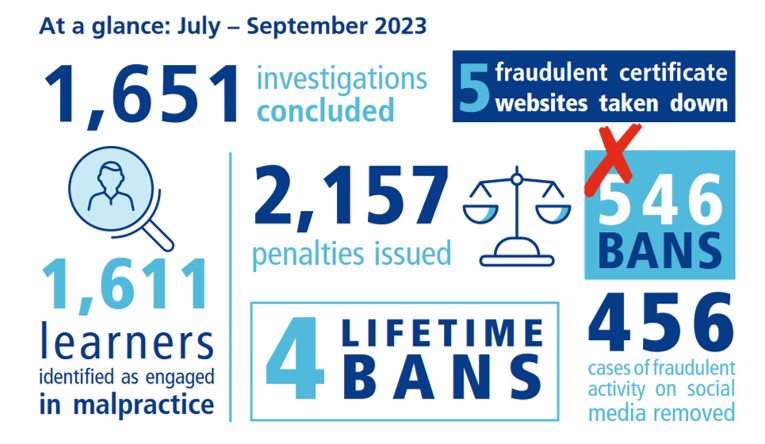
This edition of the NEBOSH quarterly Ethical Practice Report (July – September 2023) gave the following overview of recent malpractice cases and the penalties and sanctions given:
If you have any evidence about possible malpractice, please report it to NEBOSH at: postassessment@nebosh.org.uk.
All of the past Ethical Practice Reports can be downloaded from the NEBOSH website here: https://www.nebosh.org.uk/guidance/ethical-practice-report
IOSHJobs launches new advice hub
IOSHJobs launches new advice hub with helpful guidance for all stages of your Health and Safety career !
UK Christmas Holiday – Office Closure
UK Christmas and New Year Holiday – Office Closure
Our team will be taking an extended break for the Christmas and New Year Holiday period and our office will be closed during this time.
- Our office will close at 1.30pm on Thursday 21 December 2023.
- Our office open again at 8.30am on Wednesday 03 January 2024.
While we will not be able to answer the phone while the office is closed, we can still be contacted by e-mail on info@woodwardgroup.co.uk over this period.
We would like to wish everyone a very happy Christmas and a safe and healthy New Year!

NEBOSH Graduation & Awards Ceremony 2023
We were honored to be invited to attend the NEBOSH Graduation & Awards Ceremonies which took place on Monday 11 September 2023 at the University of Warwick as VIP guests, accompanying our learner Lindsay Platt who won the Award for the best candidate in the NEBOSH Health and Safety Management for Construction (UK) qualification.
Woodward retains NEBOSH Gold Learning Partner Status following their recent Audit
NEBOSH conducts an in-depth audit every two years of each NEBOSH Learning Partner and assesses them based on their performance against the Learning Partner Programme’s 6 Principles, which are:
– Ensure all learners understand what is expected of them and what they can expect from their Learning Provider.
– Create a learning environment that is engaging and encourages interaction that is appropriate for the course and type of delivery.
– Provide accurate course materials and continually update and improve them.
– Ensure tutors are qualified, knowledgeable, competent and engaging.
– Give learners feedback on their progress and provide appropriate support.
– Review course delivery and learner feedback and action as necessary.
Learning Partners are then allocated Gold, Silver or Bronze status under the scheme.
Gold status is only awarded to those Learning Partners who greatly exceed in delivering against these 6 principles. It highlights Learning Partners that provide their learners with the best possible training experience.
Needless to say all of our staff and tutors are very pleased !

UK Summer Holiday – Office Closure
UK Summer Holiday – Office Closure
Our team will be taking a break for the Summer Holiday period and our office will be closed during this time.
- Our office will close at 1.30pm on Monday 31 July 2023.
- Our office open again at 8.30am on Monday 04 September 2023.
While we will not be able to answer the phone while the office is closed, we can still be contacted by e-mail on info@woodwardgroup.co.uk over this period.
Cyber Essentials Certification awarded to Woodward SHE Ltd !
We are delighted to announce that Woodward SHE Ltd has been awarded Cyber Essentials Certification.
Cyber Essentials is a comprehensive and effective Government backed scheme that helps to protect organisations, whatever their size, against a whole range of cyber attacks. Companies bidding for Central Government contracts which involve handling sensitive and personal information or the provision of certain technical products and services now require Cyber Essentials Certification.
Woodward is proud to be able to demonstrate its commitment to cyber security and the protection we have in place for our learners, clients and employees.
You can view our Cyber Essentials Certification here: https://registry.blockmarktech.com/certificates/47d226c7-a5e9-4d15-ba5e-474ce40c3da8/
NEBOSH Case Study: Woodward SHE Ltd
“If you’re out of the military, and weighing up your career options, it’s well worth considering health and safety. You might just surprise yourself!”
NEBOSH Case Study: Woodward SHE Ltd
NEBOSH spoke to Tom Duggan Senior from Woodward SHE Ltd, a Gold Learning Partner based in Cumbria, UK about its 30th year delivering NEBOSH courses.
Tom, 2023 is your 30th year delivering NEBOSH courses to both commercial and Ministry of Defence (MOD) leavers, what made you decide to branch out to MOD leavers?
I founded Woodward SHE Ltd. in 1992 and we’ve been involved in resettlement training since the get-go, working with privates, brigadiers, and all those in between.
It was whist delivering Management Training at Catterick Resettlement Centre for the Ministry of Defence [MOD], I was asked to deliver health and safety qualifications throughout the resettlement service at both Catterick and Aldershot Garrison.
We delivered the first NEBOSH National General Certificate resettlement course for service leavers at Catterick Garrison in March 1993. We still deliver courses at Catterick Garrison, but they are held “outside the wire” (offsite) now.
In the early nineties, service leavers faced slim pickings when it came to the job market. They might be directed to the police or roles in administration, but that was more or less it. At Woodward, we recognised the potential of service leavers to succeed in health and safety.
This is why we started working with NEBOSH; to give ex-service personnel the best chance of securing jobs in health and safety, equipping them with the qualifications, knowledge, and expertise required to begin their new careers.
What transferrable skills would you say that service leavers have that help them make great health and safety professionals?
The skills required to succeed in the military transfer impressively to those required to succeed in health and safety:
A penchant for protection
Health and safety professionals take a proactive, preventative approach to injury, accidents, and equipment failure. This explains why many who leave the Armed Forces have the passion to succeed in this field – after all, the role is primarily about inspiring groups of people to take a disciplined approach to avoid dangerous, potentially life-threatening situations. The parallels aren’t difficult to spot.
A systematic approach to work
Good health and safety professionals have the discipline to see their decisions through and develop effective routines and habits. For military men and women, discipline and commitment come as standard. Planning is also vital in health and safety, just like in the military. Getting it wrong can have huge consequences, it can even be the difference between life and death.
The ability to adapt
The old military adage, ‘no plan survives first contact’, is worth bearing in mind here. It means that those who have served in the Armed Forces have to be adaptable – their lives and the lives of others could depend on it.
A soldier who, on the battlefield, is able to analyse what’s going wrong and put it right, is clearly in good stead to apply this thinking, in the context of health and safety, in the workplace.
Class communication
Communication, in particular verbal, is a skill that the military refine in their recruits. From meetings to high-pressure and fast-paced situations, service personnel must be able to communicate effectively with their comrades.
This is a skill that organisations truly value in their health and safety professionals. Those that can make a plan, solve a problem and resolve a conflict, all while communicating with the wider workforce, contribute immensely to the success of an organisation.
What are the benefits of transitioning into a career in health and safety?
It’s a highly rewarding profession that involves supporting health and wellbeing and keeping workers safe so they can return home to their loved ones. You could even save lives.
Forget the stereotypes – it’s not just about clipboards and hi-vis jackets. Health and safety professionals are fundamental to modern businesses and play a key part in preventing workplace injuries, ill-health and deaths by managing the day-to-day risks that workers face. They help organisations stay legally compliant as well as drive business processes and culture to create a sustainable, healthy and productive workforce.
Also, it’s never dull! A career in health and safety will present new challenges daily.
Can you tell us how Enhanced Learning Credits (ELC) work and the benefits of using them?
The MOD’s Enhanced Learning Credits (ELC) Scheme promotes lifelong learning amongst members of the Armed Forces. Providing financial support in three separate financial years, the scheme enables service leavers to study a nationally recognised qualification at Level 3 or above with an ELCAS approved Learning Provider.
But what are the benefits? Historically, employers have been reluctant to employ former service personnel. Why? Well, one of the main sticking points was employers saying, “they don’t have any qualifications we recognise”.
By helping service personnel use their ELCs to achieve NEBOSH qualifications, we’ve given employers a clear way of measuring their capability. We’ve challenged stereotypes and outdated mindsets; giving the people we work with a new-found status and confidence to go into the job market.
What would you say to those thinking about leaving the MOD and considering a career in health and safety?
I really would say if you’re out of the military, and weighing up your career options, it’s well worth considering health and safety. You might just surprise yourself.
Originally published on the NEBOSH website here: https://www.nebosh.org.uk/our-news-and-events/case-studies/if-youre-out-of-the-military-and-weighing-up-your-career/